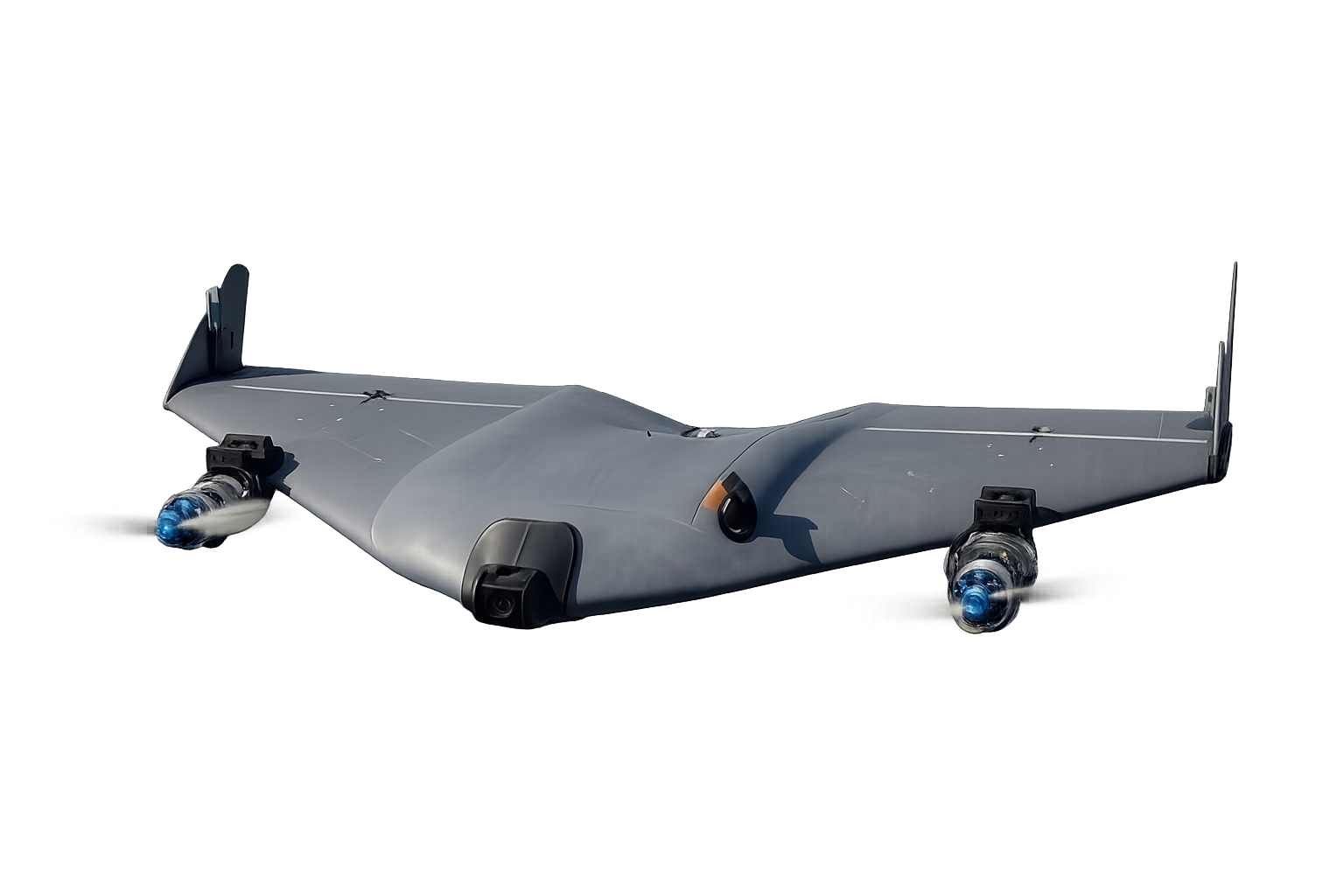
CLASS · MEDIUM-RANGE · MTOW 10.5 KG · ENDURANCE 90 MIN · CRUISE 110 KM/H · MAX 260 KM/H
// SYSTEM OVERVIEW
SPECTER is a high-speed vertical interceptor UAV developed in Ukraine for engagement of aerial threats in contested electronic warfare environments.
The platform is designed for rapid interception of aerial threats such as loitering munitions and reconnaissance UAVs, operating as part of layered air defense systems.
// GUIDANCE & AUTONOMY
Custom ArduPilot-based flight stack
Autonomous takeoff, transition and navigation
Manual, AI-assisted or automated terminal engagement
AI target highlighting support
Return-to-base capability
// EW RESILIENCE
GNSS not required for mission completion
Ground beacon-supported navigation
Encrypted digital control and video link
Operational capability under GNSS disruption
// OPERATIONAL VALIDATION
SPECTER has been deployed in real operational conditions. Early combat use includes multiple battlefield missions, over 3.5 hours of operational aerial patrol, and a long-range pursuit mission of approximately 42 km against a Shahed-type UAV.
// STATUSAlready battle-proven.
// CONFIGURATION
Type
VTOL Flying Wing (Pure Tailsitter)
Launch
Fully autonomous vertical takeoff
Transition
Fully autonomous
Landing
Belly recovery
Propulsion
Dual puller electric motors
Power
Battery-electric
// MISSION PROFILE
Interception of Shahed-class loitering munitions
Neutralization of reconnaissance UAVs
Operation within layered air defense systems
Static or mobile deployment
Crew: 2-3 operators
Deployment time: ~5 minutes
Reaction time: < 1 minute
// PERFORMANCE
Maximum speed
260 km/h
Cruise speed
110 km/h
Stall speed
75 km/h
Operational ceiling
up to 5,000 m
Operational altitude
from 400 m
Typical intercept altitude
~1,500 m
Endurance
up to 90 min
Combat radius
42 km
Max flight range
120 km
MTOW
10.5 kg
Warhead
500 g
Battery
8s4p
Control / video link
Sine.Engineering
Dimensions (W×L×H)
720 × 680 × 310 mm
AUTOMATIC THREAT DETECTION AND INTERCEPTION
The UAS SPECTER is currently operating in the combat zone in coordination with a network of air-threat detection and tracking systems and is operated by an operator via the flight control system.
The UAV is equipped with an automatic air-target detection and tracking system.
Automated control technologies are battle-proven, with validated performance in real combat operations.
CONTINUOUS DEVELOPMENT TO EXTEND CAPABILITIES
The system is actively being improved to increase survivability, integration and scalability in line with the latest UAV technological advances.
SEAMLESS INTEGRATION WITH EXISTING SYSTEMS
Full compatibility with radar-type systems already in use ensures straightforward integration into existing military infrastructure and air-defense networks.
NAVIGATION IN GPS-DENIED ENVIRONMENTS
Integration with navigation devices capable of operating under GPS suppression enables reliable operation in electronic warfare (EW) environments.
GROUP CONTROL OF MULTIPLE UNITS
A single operator can control multiple UAVs simultaneously via swarm or group-control algorithms, enabling coordinated interception, area defense and other mission scenarios.
LONG-RANGE REMOTE CONTROL
The system supports long-range UAV control over internet infrastructure through a secure custom VPN architecture.
// COMPARATIVE ANALYSIS · INTERCEPTOR CLASS POSITIONING
Air defense against small aerial threats spans five interceptor classes, each optimized for different ranges, costs and mission profiles.
CLASS 01
HIGH-SPEED FPV
Very small, extremely fast; short-range interception of nearby targets.
CLASS 02
SHORT-RANGE FIXED-WING
Compact aircraft for moderate-distance engagement; higher endurance than FPV.
CLASS 03
MEDIUM-RANGE UAVS
Extended range and endurance for patrol and long-distance interception of loitering munitions and recon UAVs.
CLASS 04
MISSILE-BASED
High-performance, expensive solutions used for high-value targets.
CLASS 05
MANNED AIRCRAFT
Capable but costly; limited availability for continuous coverage.